History
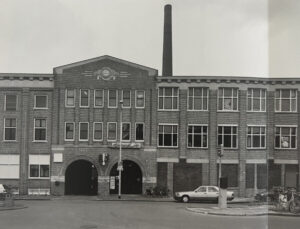
For more than 40 years, Simplon has been a centre where young people and youth culture play a very important role. Groningen is a student city with a vibrant pop and youth culture. And because youth culture is constantly changing, Simplon has also changed frequently. It all started with a canning factory and later a coat factory from the beginning of the last century on a canal north of the centre of Groningen, the Boterdiep.
In the early 1970s, the Simplon building stood empty and was squatted by hippies and artists who organised sessions and concerts there. Later, the adjacent building at number 69 was added. A characteristic feature of the Simplon hall was “the pit”: the floor in the middle of the hall was sunken, creating an intimate atmosphere. 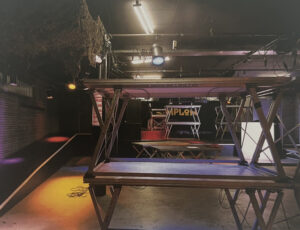
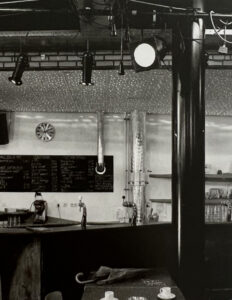
In the early 1980s, punk culture gained the upper hand and legendary punk concerts were organised at Simplon. Simplon was, for example, the home stage of the Boegies, one of the Netherlands’ most famous punk bands. Volunteers have always been very important to Simplon. In the 1980s, more and more people became involved in the concerts, providing support services: sound engineers, lighting technicians, photography, video technology, design, screen printing, computer workshop and offset printing. New activities included the bar, the eatery and the cinema. Later, the emphasis shifted to a progressive cultural function. In the 1990s, Simplon was at its peak with over 150 volunteers and daily public activities, such as underground concerts, metal concerts, house parties, feature films, a restaurant and café, and more than 15 support departments, all run entirely by volunteers.
As the 1990s approached, Simplon’s very survival came under threat: Simplon was facing financial difficulties, and politicians felt that Simplon and Vera were too similar. Both centres were threatened, in turn, with the withdrawal of funding from the local council. Ultimately, it was decided that Simplon would adopt a cultural and social focus, funded by the social welfare department. The combination of taking on staff with little affinity for youth culture and increasing financial burdens due to the significant rise in the number of paid staff members led to a period of turmoil once again. Concerts and dance parties had to be cancelled, and the noise levels at dance evenings were restricted. Even a drum kit from an ordinary band was deemed too loud, meaning that only muted and unamplified performances could be organised. Despite efforts by the programming team to put together a good programme within these constraints, the public stayed away in droves, resulting in plummeting takings and further financial problems for Simplon. Following protests by the volunteers in every possible way, the local council decided to continue its funding after all and, moreover,
funding was secured for a major refurbishment to improve the building’s sound insulation. After three years of uncertainty, the tide seemed to be turning for Simplon in 2000. The entire building underwent a thorough refurbishment; the main hall could now accommodate 400 visitors instead of just over 300, whilst the first floor was fitted out with a small hall, a café and a chill-out area for up to 200 visitors. In early 2002, the premises were festively reopened.
 end.The policy was also overhauled. A completely new, dynamic board and new management team were appointed, and the organisation was professionalised. The volunteers largely disappeared and were replaced by on-call and agency staff. Simplon was no longer a youth centre: the role of the youth worker had disappeared. Activities became increasingly focused on culture, and in particular music, which young people were keen on. Simplon was renamed the Youth Culture Centre. Unfortunately, in 2003 it looked as though the curtain was about to fall on Simplon once again. Due to the alleged failure to reach the target group – young people in vocational secondary education (VMBO), a requirement imposed by the welfare department – substantial cutbacks were implemented. Once again, campaigners took decisive action. This time, the local council saved Simplon. That
was not to last long. Between 2005 and 2006, Simplon’s funding was transferred from the welfare department to the culture department. However, there was once again a lack of clarity from the local authority regarding the policy Simplon should pursue; they now felt there was too little focus on culture and threatened to withdraw the funding entirely. Ultimately
Simplon’s grant was cut by over 22 per cent! So, financially speaking, it’s unfortunately back to pre-2000 levels!
After 29 years of balancing welfare and culture, the name was changed to Poppodium Simplon in 2006. With a new board and a reorganisation of its permanent staff, Simplon has got its affairs back on track. A completely independent programme has been set up and a new audience has been tapped into. Dance and hip hop in the broadest sense of the word have taken a prominent place in the programme, which also includes pop, punk, rock, jazz and metal. And, of course, local talent is given every opportunity to showcase itself. Simplon also works mainly with volunteers rather than paid staff. Thanks to all these changes, Simplon has undergone a positive transformation over the past year. Visitor numbers are rising and the approximately 75 volunteers bring a positive and enthusiastic atmosphere to the pop venue.
In 2010, Simplon was nominated by the VNPF for the title of “Best Pop Stage in the Netherlands” for the first time in its history.
(source: Wikipedia, Simplon monthly newspapers, among others)